Introduction
The world of crypto moves fast—blink and a new token is born. But before coins hit exchanges and headlines, they begin in the primary crypto market. If you’ve ever wondered how investors get in early—before the hype, before the price spikes—you’re about to uncover how it all works.
The primary crypto market is where new digital assets are first created and sold to investors. It’s the crypto equivalent of an IPO in traditional finance. For early adopters, this phase can mean massive upside. For the unprepared, it can also mean serious risk.
Understanding this market isn’t just for hardcore traders. Whether you’re a cautious investor or someone curious about blockchain startups, knowing how early-stage token sales function gives you a powerful edge in today’s digital economy.

What Is the Primary Crypto Market?
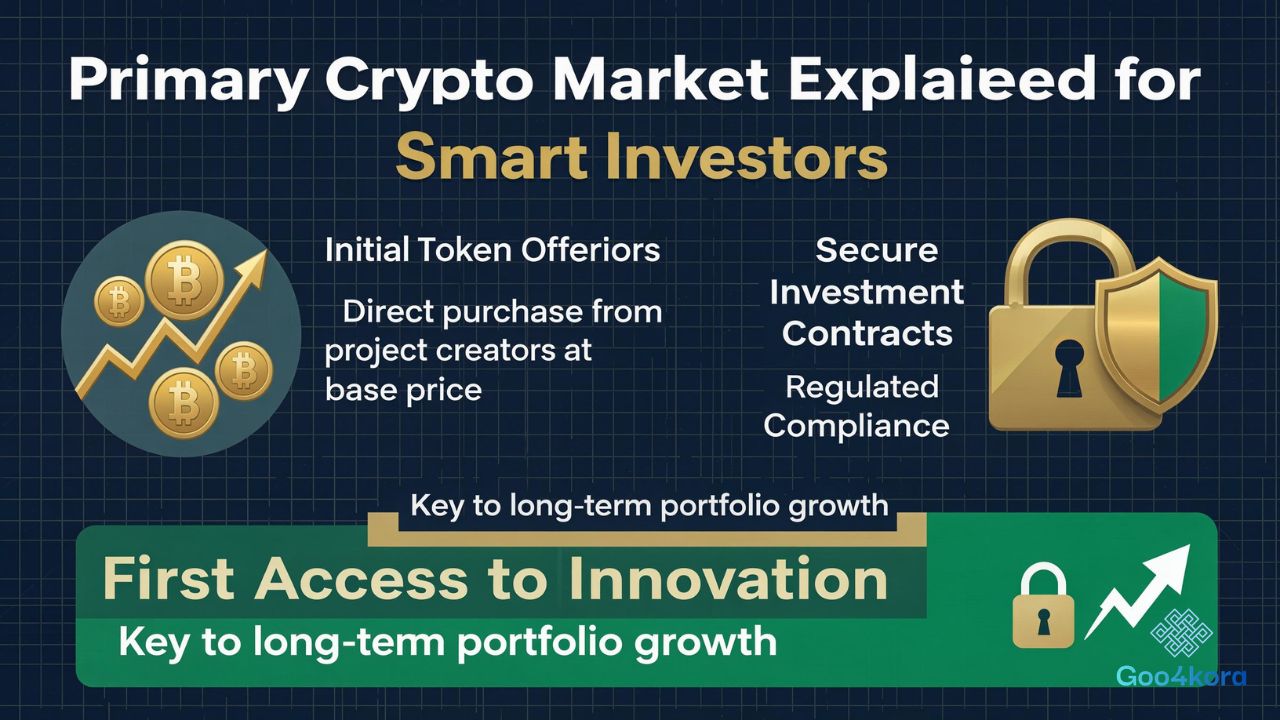
The primary crypto market is the environment where newly created cryptocurrency tokens are offered to investors for the first time. This happens before tokens are listed on exchanges like Binance or Coinbase.
In traditional finance, companies raise capital through an Initial Public Offering (IPO). In crypto, projects raise funds through methods such as Initial Coin Offerings (ICOs), Initial Exchange Offerings (IEOs), and Security Token Offerings (STOs).
In simple terms, this is the “birthplace” of digital assets. Investors exchange capital—usually Bitcoin, Ethereum, or stablecoins—for newly minted tokens that represent utility, governance rights, or future value within a blockchain ecosystem.
The primary crypto market plays a vital role in funding innovation across Web3, decentralized finance (DeFi), gaming, NFTs, and blockchain infrastructure projects. Without it, many crypto startups simply wouldn’t exist.
How the Primary Crypto Market Works
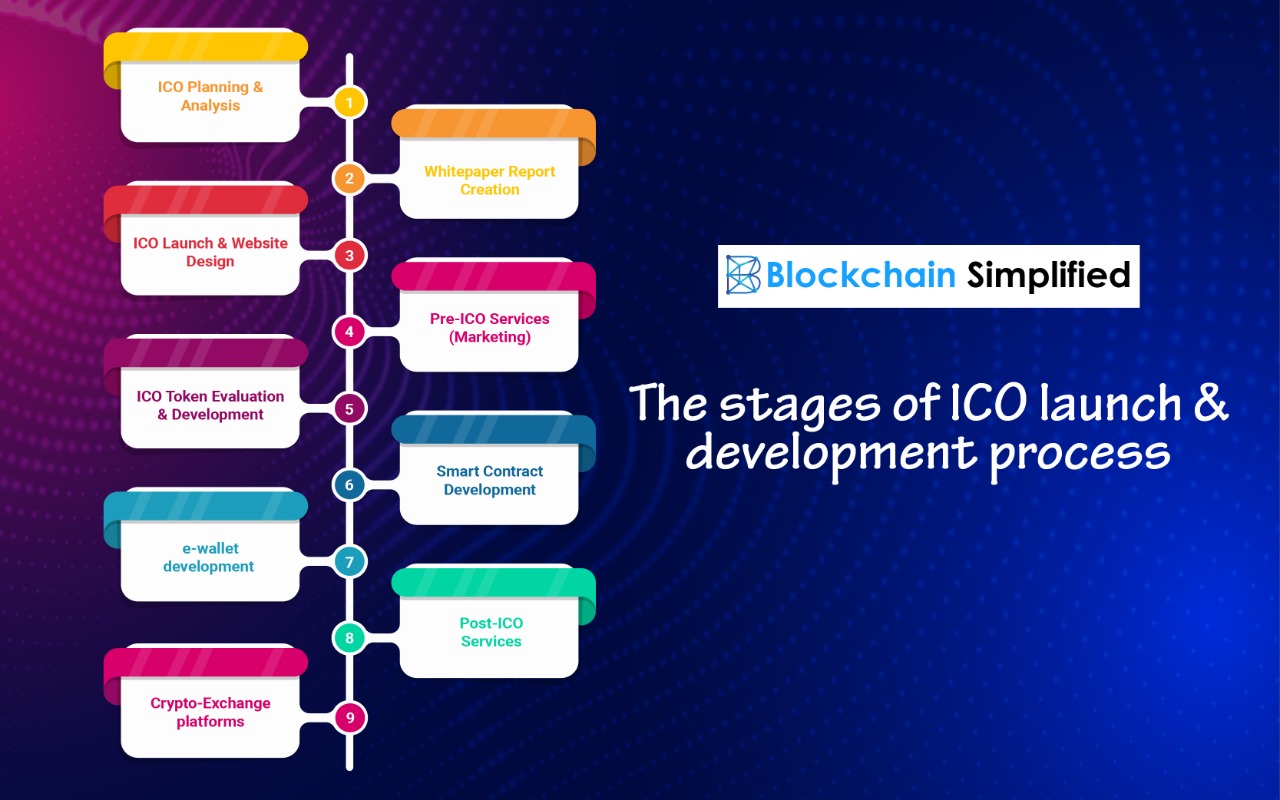
1. Project Development
Every token launch begins with a concept. A team identifies a problem—say, slow cross-border payments—and proposes a blockchain-based solution. They develop a whitepaper outlining:
- Vision and roadmap
- Token utility
- Distribution plan
- Fund allocation
- Governance model
2. Token Creation
Tokens are created on blockchain platforms such as Ethereum or Binance Smart Chain using smart contracts. Tokenomics—how many tokens exist, supply caps, and allocation percentages—are defined at this stage.
3. Fundraising Phase
During the token sale, investors participate in:
- Private sale (VCs and early backers)
- Pre-sale
- Public sale
Prices are typically lower during early rounds to reward initial risk-takers.
4. Token Distribution
After the sale ends, tokens are distributed to wallets. Some tokens are vested—meaning investors can’t sell them immediately—to prevent price crashes.
5. Secondary Market Listing
Once listed on exchanges, trading begins. At this point, the asset moves from the primary crypto market to the secondary market.
Key Participants in the Primary Crypto Market
Understanding who operates within this space is essential.
Founders and Core Teams
These individuals design and build the blockchain project. Their experience often determines success. Many prominent founders, such as Vitalik Buterin, gained recognition after launching tokens that transformed the industry.
Venture Capital Firms
Crypto-focused VC firms like Andreessen Horowitz actively invest in early-stage blockchain startups, often during private funding rounds.
Retail Investors
Everyday investors participate during public sales. While access has improved, retail buyers often face allocation limits.
Launchpads & Exchanges
Platforms help projects raise funds securely and conduct KYC verification.
Types of Token Offerings
The primary crypto market includes various fundraising models:
Initial Coin Offering (ICO)
The earliest and most popular model. Projects sell tokens directly to the public.
Initial Exchange Offering (IEO)
Conducted through exchanges. The exchange vets the project, offering additional trust.
Security Token Offering (STO)
Tokens represent real-world assets or equity and comply with securities regulations.
Initial DEX Offering (IDO)
Tokens are launched through decentralized exchanges, enabling faster liquidity.
Each model comes with unique regulatory and risk profiles.
Benefits and Risks of Investing Early
Benefits
- Lower entry prices
- High growth potential
- Early governance participation
- Access to innovation
Early investors in Ethereum’s 2014 ICO reportedly purchased ETH at around $0.30. Years later, prices reached thousands of dollars—a life-changing return.
Risks
- Project failure
- Scams and rug pulls
- Regulatory bans
- Token dilution
- Market volatility
In reality, many early projects never survive beyond development stages.

Regulatory Landscape and Compliance
Regulation remains a gray area globally. Countries like the U.S. evaluate token offerings under securities law. Agencies assess whether tokens meet the Howey Test criteria.
Meanwhile, jurisdictions like Singapore and Switzerland have built clearer crypto frameworks to attract innovation.
Regulation can impact token price, investor eligibility, and platform compliance. That’s why understanding the legal environment before investing in the primary crypto market is critical.
Personal Backgrounds of Crypto Founders & Financial Insights
The success of a token often mirrors the credibility of its leadership.
Take Changpeng Zhao, founder of Binance. His early involvement in crypto infrastructure and exchange technology contributed significantly to Binance’s explosive growth.
Similarly, visionary founders with strong technical backgrounds and transparent communication tend to attract more institutional backing.
Estimated net worth figures of top crypto founders frequently fluctuate due to token price volatility. However, during peak bull markets, several founders reached billionaire status, demonstrating how influential the primary crypto market can be in wealth creation.
Strategies to Succeed in the Primary Crypto Market
Investing early isn’t about luck—it’s about research.
1. Analyze the Whitepaper
Look for:
- Clear use case
- Realistic roadmap
- Transparent token allocation
2. Study Tokenomics
Check:
- Circulating supply
- Vesting schedules
- Inflation rate
3. Evaluate the Team
Research LinkedIn profiles, prior experience, and community presence.
4. Assess Community Engagement
Healthy projects have active Discord, Telegram, and Twitter communities.
5. Diversify Investments
Never allocate all capital to one token sale. The primary crypto market is high-risk by nature.
6. Monitor Market Conditions
Bull markets amplify token launch success. Bear markets reduce liquidity and investor appetite.
FAQ
Frequently Asked Questions
What is the difference between the primary crypto market and secondary market?
The primary crypto market is where new tokens are sold for the first time. The secondary market is where tokens are traded after listing on exchanges.
Is investing in the primary crypto market risky?
Yes. While returns can be significant, risks include scams, regulatory crackdowns, and project failure.
How can I participate in token sales?
You can join launchpads, participate in whitelist registrations, or invest through exchanges offering IEOs.
Are ICOs still popular?
ICOs are less common than in 2017, but fundraising models like IDOs and IEOs have become more prevalent.
What is token vesting?
Vesting locks tokens for a period to prevent early investors from selling immediately.
Can beginners invest in the primary crypto market?
Yes, but beginners should start small, conduct thorough research, and understand blockchain fundamentals.
How do regulations affect token launches?
Regulations determine investor eligibility and compliance requirements, influencing project legitimacy and stability.
Conclusion
The primary crypto market is where innovation meets opportunity. It’s the launchpad for tomorrow’s blockchain giants and the testing ground for bold ideas.
For investors, it represents both promise and peril. Those who approach it with research, patience, and disciplined risk management can uncover extraordinary growth potential.
That said, no investment is guaranteed. The key is education. When you understand how the primary crypto market operates—from tokenomics to regulation—you transform from a speculative gambler into a strategic participant in the evolving digital economy.